
Imaging Resource 2025 Editor’s Choice – Best Cameras and Lenses of 2025


Table of Contents
 Canon EOS R6 Mark III
2025 was an interesting and largely exciting time for photography, though the looming shadow of uncertain tariffs made it feel at first like camera companies were holding back. We thought it might be hard to pick the Imaging Resource’s best cameras and lenses of 2025 because of a lack of products. Boy, were we wrong. By the end of the year, we had already reviewed dozens of products, with more certainly to come in the first few months of 2025.
We found almost no mediocre products this year, which made picking these winners more difficult than in years with a slower rollout of products. A few of my personal favorite lenses got cut, for example, simply because there were so many showstoppers.
While in previous years the camera companies looked to be cramming as many photo and video features as possible into their hybrid bodies, it’s starting to look like we will see more specialized bodies going forward, at least based on what we saw in 2025. There were cameras positioned for the stills photographer, and cameras aimed at the video crowd. Maybe it’s the growing demand for video content that’s driving this change.
Rather than pick the most expensive products, which tend to have good performance just because of their prices, we chose winners based on how they perform for the target customer, but we also looked to see if the candidates would help a photographer or videographer creatively grow, thanks to the products.
While these are our picks for the best cameras and lenses, there were still dozens of products this year that are perfect for all types of photographers and videographers. It’s truly a great time to be a creator, and we’re hoping 2026 gets even better.
And with that, here is the 2025 Imaging Resource Editor’s Choice for Best Cameras and Lenses
Cameras
Canon EOS R6 Mark III
The Canon EOS R6 Mark II is the most interesting camera we reviewed this year, by far.
It is one of the most video-centric mirrorless cameras currently available, and it’s a monster for both photography and videography. A significant upgrade over the R6 Mark II, the R6 Mark III can capture at 40fps with an electronic shutter and uses Canon’s excellent Dual Pixel CMOS AF II subject detection autofocus.
The reason that this is our pick for Best Camera of 2025 isn’t the still photography frame rate or AF or the nice balance of resolution and low-light abilities of the 32-megapixel sensor; we picked it for its amazing video capabilities. The R6 MK III is such a good camera for video that every other camera released this year is being compared to it.
The standout feature is 7K Open Gate RAW internal recording, pro-level capabilities squeezed into a hybrid body. It also records full DCI 4K, Long GOP, and has C-Log and C-Log 3 profiles. It can also shoot 180fps Full HD, and 120fps 4K UHD or DCI. In short, this is a video beast that is also a still photography superstar.
The Canon R6 Mark III shares most of the features of the cine-style C50, but is a much more compelling offering. Phonomeal still photography features means users will have the best of both worlds, something that hybrid camreas are suppsed to be all about.
If you only shoot stills, this camera is overkill, but for mixed-use shooters, this is a knockout.
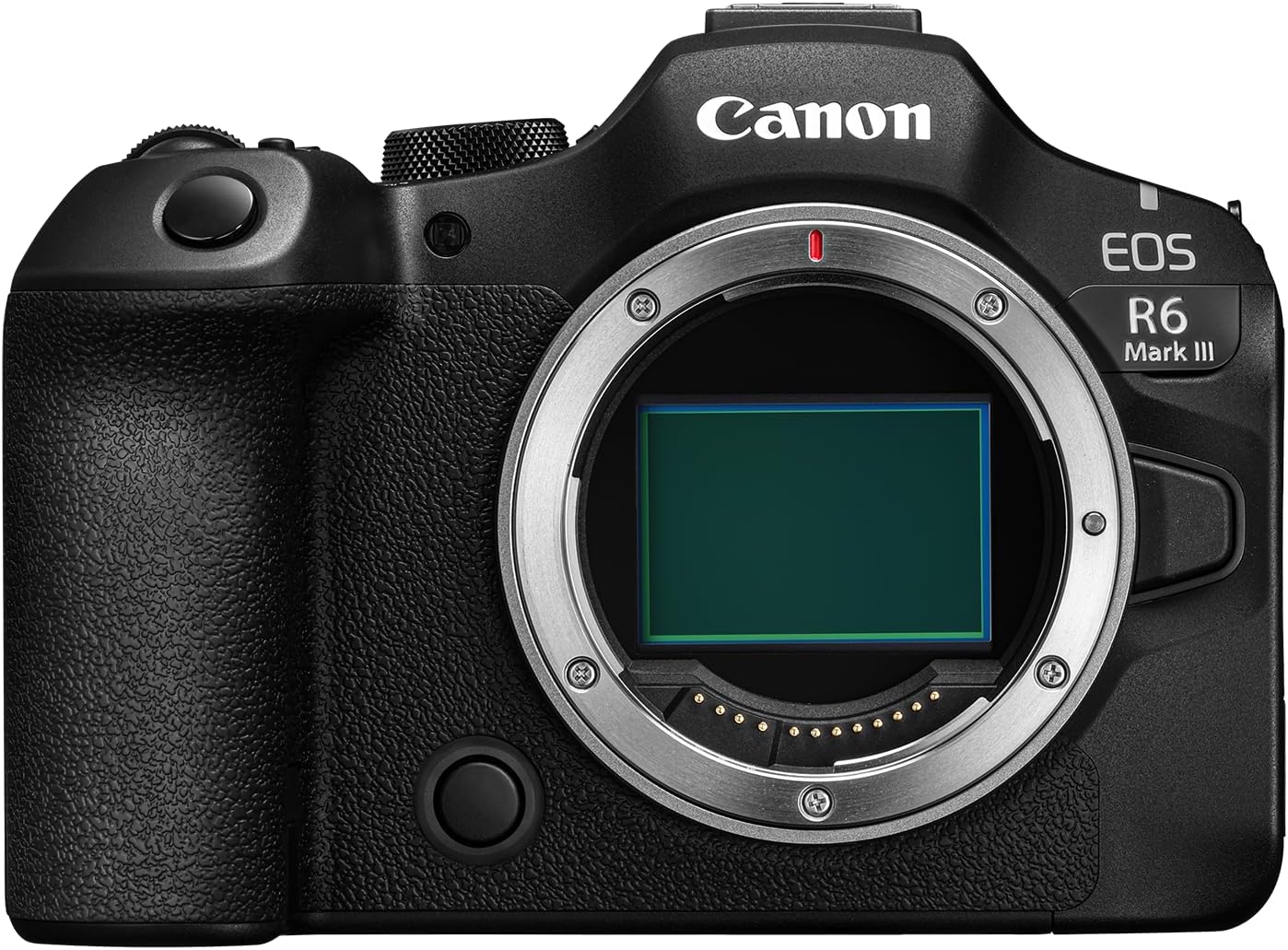
- Flagship-level autofocus system borrowed from the Canon R1 provides exceptional subject tracking and recognition across multiple subject types.
- Comprehensive video features, including 7K oversampling, C-Log profiles, and open gate recording, rival dedicated cinema cameras.
- 40fps electronic shutter with pre-capture function ensures capturing decisive moments in fast-action scenarios.
- Overheating can occur during extended video recording sessions, though workarounds exist.
- Lacks an in-body cooling fan found in the Cinema EOS C50, limiting sustained recording times.
- Higher price point compared to previous R6 iterations may be prohibitive for entry-level users.
- Sensor: 33-megapixel full-frame CMOS
- Autofocus: Dual Pixel CMOS AF II with subject detection
- Continuous Shooting: 40fps electronic shutter, 12fps mechanical shutter
- Video: 7K oversampled 4K, C-Log 2/3, open gate recording
- Image Stabilization: 6.5-stop in-body image stabilization
- Viewfinder: High-resolution OLED EVF
Nikon Z5 II
The Nikon Z5 II quickly became one of my favorite cameras when I tested it. It’s one of the most affordable cameras in its class, coming in around $1,600. For someone getting into photography who wants a great camera that’s powerful, yet priced like an entry-level camera, this is the one.
Specs are excellent. It has a 24-megapixel BSI sensor and uses the EXPEED 7 processor also found on its more powerful siblings. The sensor size and construction make this camera perfect for low-light scenes. I shot test around and after the sun set, and the images surprised me because of the lack of noise.
Subject detection AF (nine subject types) worked well, and in our tests, it had a great hit rate. It can capture in electronic shutter at up to 30 frames per second (in JPEG) and has pre-release capture, excellent for wildlife and sports.
Video specs are excellent as well, with the ability to capture 10-bit N-RAW internally, the only camera we know of in this price range that can shoot internal RAW.
As with Canon, Nikon’s first mirrorless cameras were not on par with its DSLR offerings, which is completely understandable for first-generation devices. With the Z5 II, Nikon has rounded out the lineup, and its cameras are now powerhouses.
The body is also smaller than the Z7 or Z8, but it doesn’t compromise much to squeeze this tech into a body that’s the perfect size for travel.
It might seem strange to rank a camera as “best” partially due to price, but in this case, the price-to-performance ratio is off the charts. We don’t think customers understand how impessive it is that Nikon is turning out cameras comparable to the competition for a fraction of the price. At around $1600 you’d be hard pressed to find a more rounded set of features, and it’s a perfect entry point to Nikon’s now-powerful mirrorless camea lineup.
Watch Our Hands On Review Video
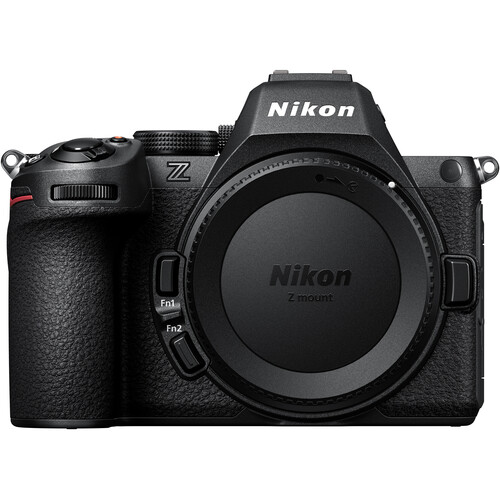
The Nikon Z5 II is a full-frame mirrorless camera with a 24.3-megapixel CMOS sensor and the EXPEED 6 processor. It supports 4K UHD recording up to 60 fps (with a 1.7× crop) and Full HD at 120 fps. The camera includes 5-axis in-body image stabilization, a 273-point hybrid autofocus system with subject detection, and dual UHS-II SD card slots. It features a 2.36-million-dot EVF, 3.2-inch tilting touchscreen, weather-sealed magnesium alloy body, and USB-C power delivery. Connectivity options include Wi-Fi and Bluetooth for wireless transfer and tethering.
- Excellent autofocus with subject detection for people, animals, vehicles, and airplanes
- Outstanding low-light performance with usable images up to ISO 12,800
- Compact and lightweight body ideal for travel
- 5-stop in-body image stabilization
- Dual card slots (CFexpress Type B/XQD and SD UHS-II)
- Clean 4K video with 10-bit N-Log recording
- Flip-out LCD perfect for vlogging and self-recording
- Excellent battery life and menu system
- Pro-level features at an accessible price point
- Electronic shutter limited to 10 fps (5 fps mechanical)
- Video features don’t match the Z6 III for serious videographers
- 24-megapixel resolution is lower than that of some competitors ‘
- Sensor: 24.5MP Full-Frame BSI CMOS
- Processor: EXPEED 7
- Video Resolution: 4K 60p
- Continuous Shooting: 30 fps (electronic)
- Stabilization: 7.5-stop VR
- Viewfinder: 3.69m-Dot OLED EVF
- LCD: 3.2″ 2.1m-Dot vari-angle touchscreen
- Battery Life: Approx. 360 shots (CIPA)
Sony a7 V
The Sony a7 V is the last camera announced in 2025. It replaces the long-running a7 IV as Sony’s “basic” camera. The a7 V has a 33-megapixel sensor that’s “partially stacked” and is part of a brand new design for Sony where sensor and processor are combined for faster operation. I expect to see several Sony cameras with this new sensor system design in 2026.
The autofocus in the a7 IV was starting to feel outdated thanks to Sony’s AI subject-detection AF system, but the a7 V feels as fast to lock on as the a1 II, or a9 III. While many of Sony’s cameras now have AI-driven subject detection, the addition to the a7 line alone will make the upgrade worth it for many a7 IV users.
The a7 V shoots completely blackout-free at 30fps electronic or 10 fps mechanical, and that’s combined with my favorite feature in cameras, pre-release shooting. The a7 V can capture up to one full second of images before you fully depress the shutter. Sony uses the CFexpress Type A card format, which gives the a7 V the ability to use the similarly-sized SD card as well in each of its two slots. Unlike some competitors, the 30fps shooting can be done when saving as RAW, not just JPEG.
Sony’s put dual USB-C ports in the a7 V to complement the full-size HDMI, giving it the ability to take power over one USB port while using the other for connectivity.
Video capabilities are good, though they don’t feel on par with the still-photograph capabilities, which is the main reason this wasn’t our top pick for Best Camera. It captures 4K from 7K oversampled footage, and has LOG, but doesn’t have internal RAW recording, and doesn’t capture 6K footage or Open Gate.
We think that the a7 V will find a home not only with enthusiast photographers, but will end up being a primary or backup camera for wedding, news, and sports photographers.
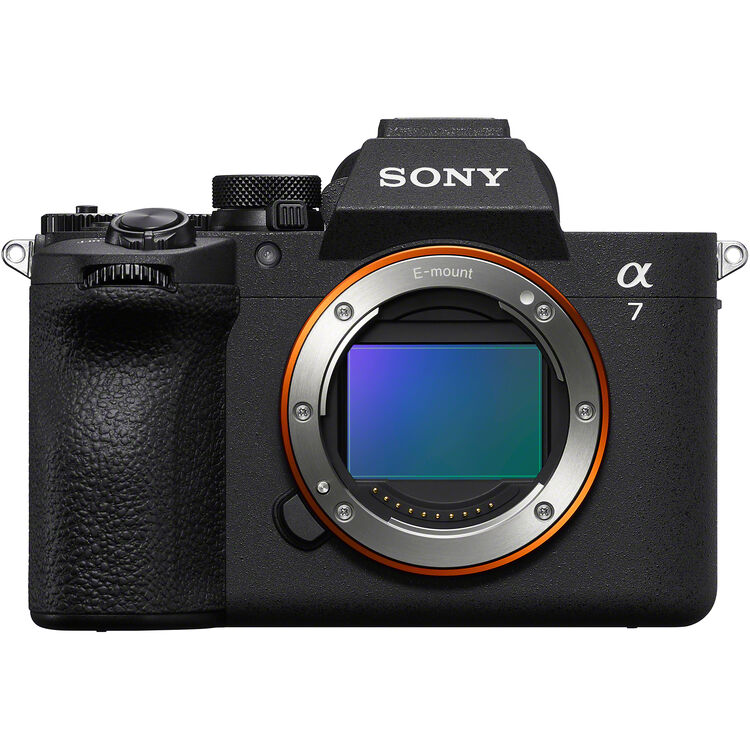
The Sony a7 V features a 33-megapixel partially stacked full-frame BSI CMOS sensor with BIONZ XR2 processor and integrated AI processing unit. It shoots blackout-free at 30fps electronic shutter and 10fps mechanical shutter with 759 phase-detection AF points covering 94% of the frame. The camera includes pre-capture functionality recording up to 1 second before shutter press at 30fps, Speed Boost function for instant burst rate switching, and buffer capacity of up to 95 compressed RAW or 185 JPEG images at 30fps with CFexpress Type A cards. Image stabilization provides up to 7.5 stops at the center and 6.5 stops at the periphery. Video capabilities include 7K oversampled 4K 60p full-frame, 4K 120p in Super 35 crop, and Full HD 240fps, all with 10-bit 4:2:2 internal recording. The camera features a 3.69-million-dot OLED viewfinder with a 120fps refresh rate, a 3.2-inch 4-axis vari-angle touchscreen, dual card slots (CFexpress Type A/SD UHS-II and SD UHS-II), NP-FZ100 battery rated for 630 EVF shots or 750 LCD shots, and full-size HDMI, dual USB-C, 3.5mm mic/headphone jacks, Wi-Fi, and Bluetooth connectivity.
- Partially stacked sensor technology delivers exceptional ISO invariance and dynamic range performance superior to competitors.
- Comprehensive feature set makes it truly versatile for both high-end stills and professional video work.
- Refined ergonomics and body design borrowed from flagship models improve handling and usability.
- Premium pricing positions it above mid-range competitors while lacking some flagship features.
- Autofocus performance, while excellent, doesn’t reach the same “sticky” tracking as the a1 or a9 III.
- Battery life is adequate but not class-leading for extended shooting sessions.
- Sensor: 33-megapixel full-frame partially stacked BSI CMOS
- Autofocus: AI-powered subject recognition
- Continuous Shooting: 30fps electronic, 10fps mechanical
- Video: 4K 60p, 10-bit 4:2:2 recording
- Image Stabilization: 5-axis in-body stabilization
- Viewfinder: High-resolution OLED EVF
Hasselblad X2D II 100C
It’s not often that a medium-format camera makes it to an Editor’s Choice award. Most medium format systems are slow, cumbersome, and heavy.
I’ve been shooting Hasselblad’s X-series since the first model arrived, and each one has been successively better, albeit with its own particular weaknesses in focusing and operational speed. The huge sensor creates a huge amount of data, and Hasselblad’s processing has always been a bottleneck.
Testing the X2D II 100C was a joy. The new AF system has more than 400 AF points and uses LiDAR to assist with focus, and whille using the camera isn’t the same as using full-frame camera, it’s closer than ever.
We’re not sure why LiDAR is found in the iPhone and in this camera, but other manufacturers haven’t added it to full-frame and APS-C cameras. Even the best AF systems could benefit from more focus data.
It’s not as fast as mirrorless cameras, but it’s fast enough for operation outside the typical portrait photography workflow. I took it to a No Kings protest, and could see myself relying on this as my sole camera if I still did photojournalism work.
Hasselblad tossed out the video workflow for this newest iteration, which does not feel like an omission as much as a choice based on the type of shooters of this camera. What it includes instead is 15-plus stops of dynamic range, 10 stops of image stabilization (claimed), and an internal 1TB drive, another thing we’d like to see on more cameras. So many shoots are ruined when a photographer leaves their memory cards at home that I’ve been waiting to see this come to cameras for years.
The X2D has a true HDR workflow, from the sensor to the HDR-capable touchscreen. Menus are some of our favorites in any system; the other camera companies could learn a thing or two from Hasselblad.
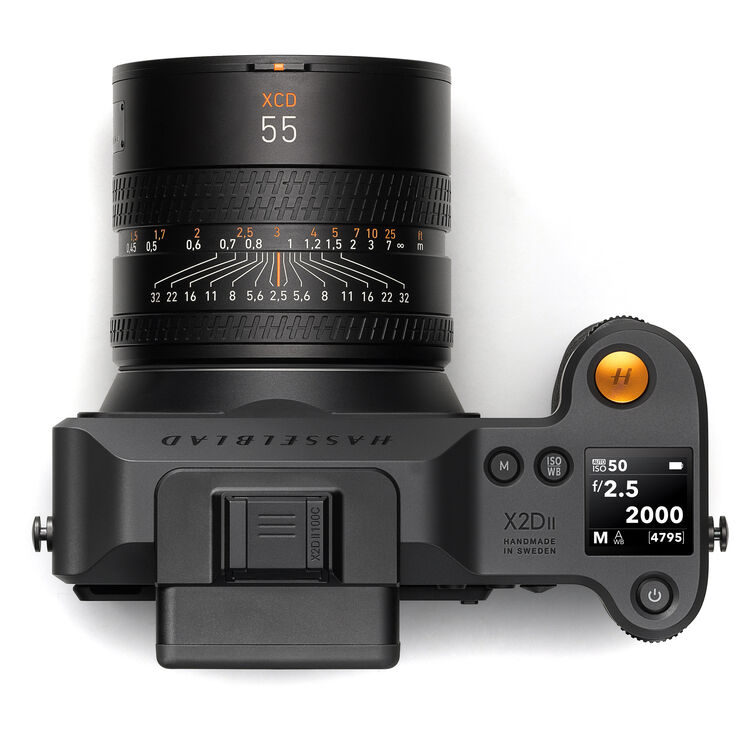
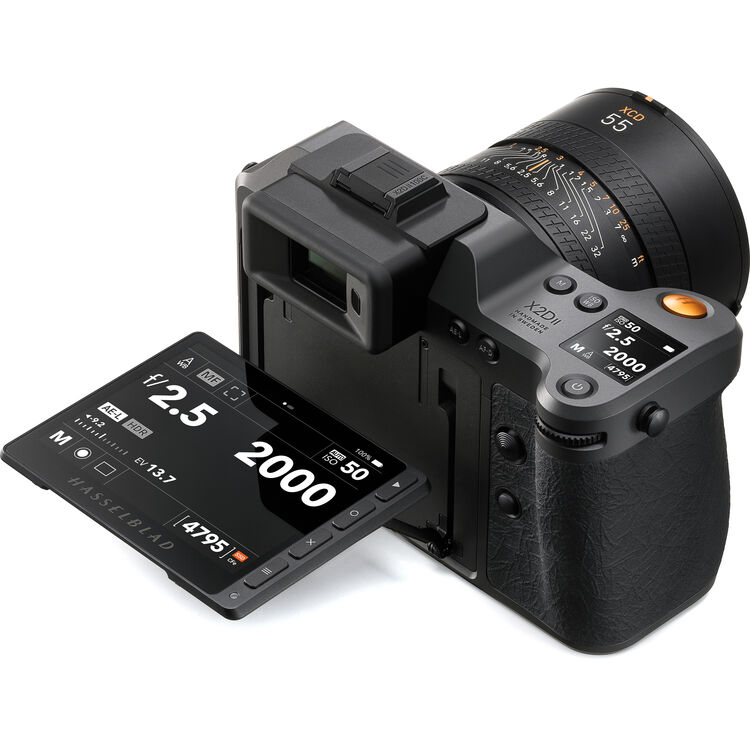
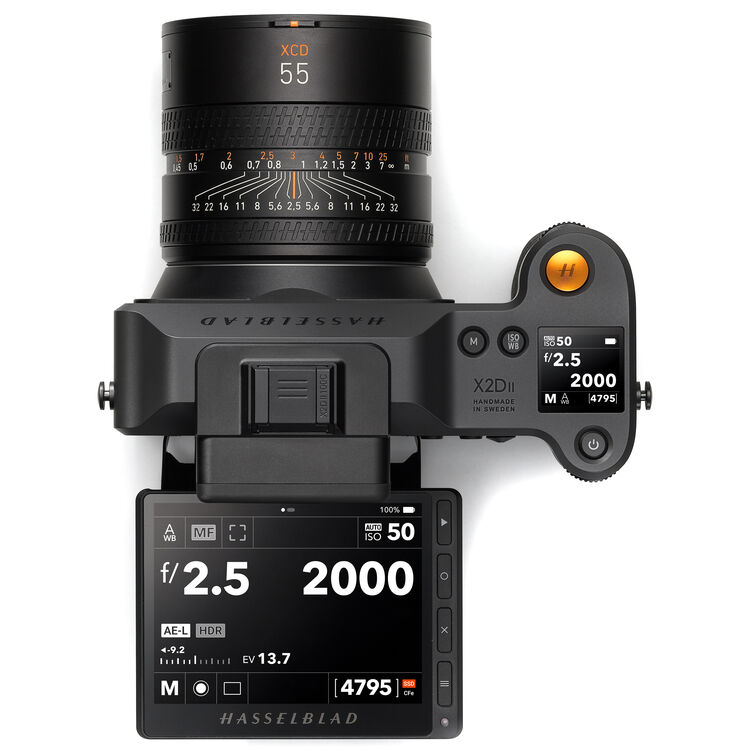
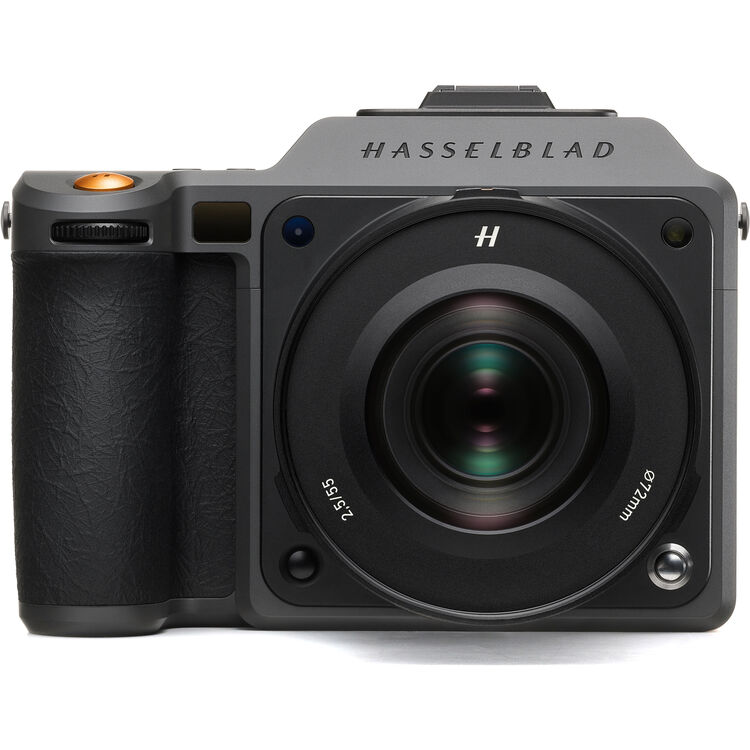
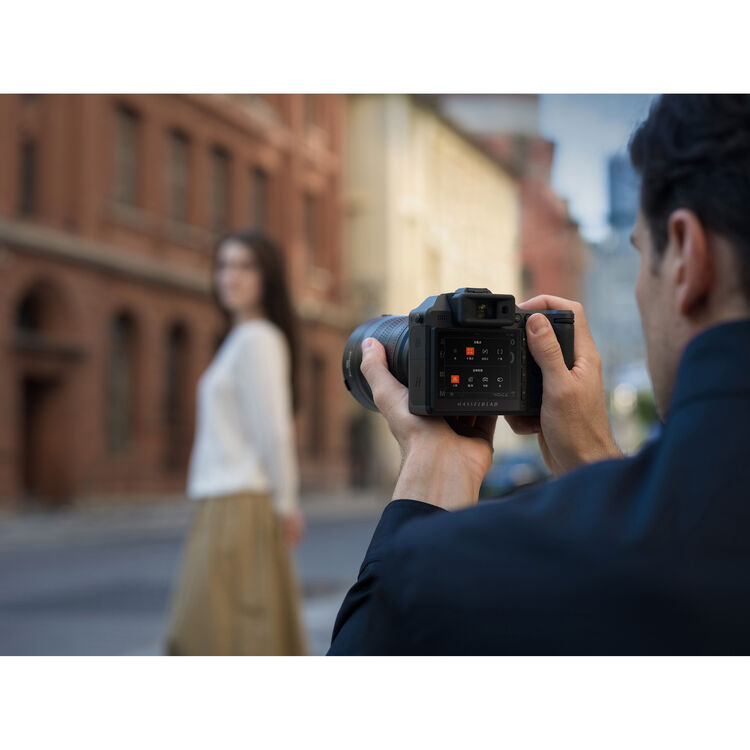
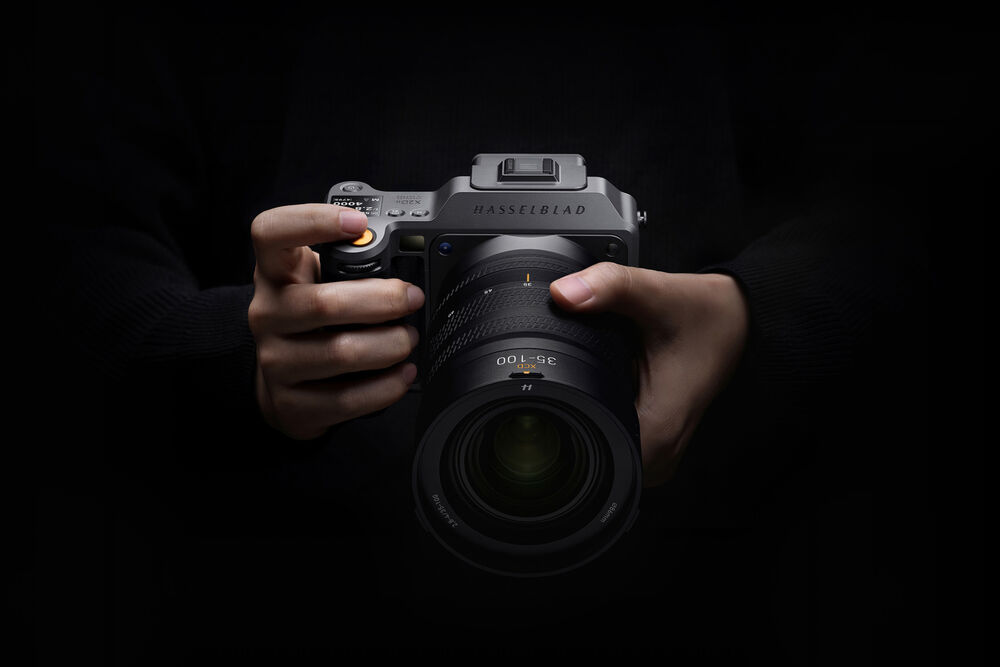
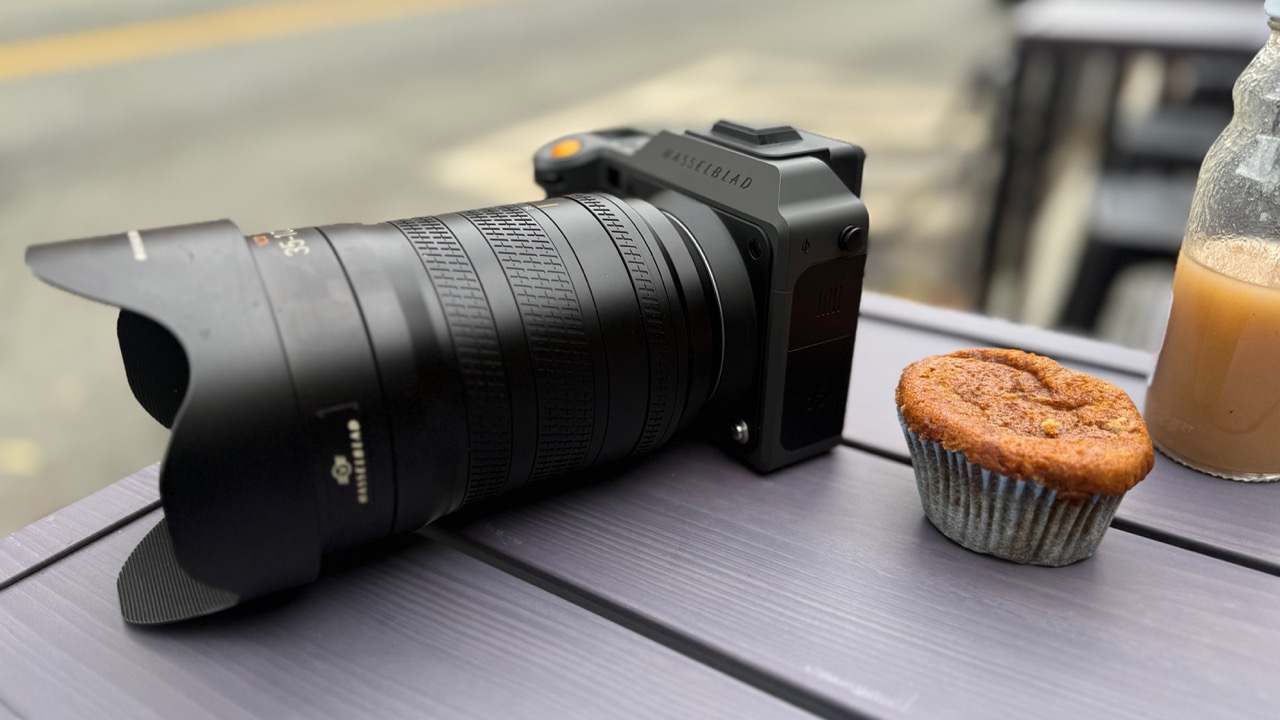
The Hasselblad X2D II 100C features a 100-megapixel medium-format back-side illuminated CMOS sensor delivering up to 15.3 stops of dynamic range and native ISO 50 sensitivity. It supports 16-bit colour depth and Hasselblad’s HNCS HDR workflow. Continuous autofocus (AF-C) is enabled via phase-detect plus LiDAR sensing and subject detection for people, animals, and vehicles. In-body image stabilization (IBIS) offers up to 10 stops of compensation. The rear 3.6-inch OLED two-way tilt touchscreen reaches up to 1,400 nits brightness and supports the P3 colour gamut for HDR monitoring. Internal storage includes a 1 TB SSD plus a CFexpress Type B card slot.
- 100 MP medium-format BSI sensor with 16-bit colour for extremely high image detail and tonal depth.
- Up to 15.3 stops of dynamic range preserves highlight and shadow detail.
- In-body stabilization rated up to 10 stops enables handheld shooting at slower shutter speeds.
- Phase-detect AF with LiDAR-assisted continuous autofocus and subject detection.
- Bright, tilting 3.6-inch OLED touchscreen (1,400 nits) supports HDR monitoring.
- Internal 1 TB SSD plus CFexpress Type B slot for fast, flexible storage.
- No video recording capabilities — stills-only camera.
- Slow burst rate (around 3 fps) limits suitability for action photography.
- Medium-format body and lenses increase overall system size and cost.
- 100 MP RAW files demand significant storage and processing resources.
- Sensor: 100-megapixel medium format BSI CMOS, 1.7 x 1.3 inches (43.8 x 32.9mm)
- Processor: Enhanced image processing engine
- Autofocus: Hybrid AF with 425 phase-detect zones, LiDAR assistance, subject detection (people, animals, vehicles)
- Continuous Shooting: Not specified (stills-focused camera)
- Video: No video recording capability
- Image Stabilization: 5-axis in-body, 10 stops
Lenses
Sony FE 50-150mm f/2 GM s
The Nikon FE 50-150mm f/2 GM is a unique lens, and just from the name, it doesn’t feel like it would be a standout lens, but it was one of my favorite lenses in our tests this year.
The focal length seems strange, but it’s perfect for portraits, photojournalism, and relatively close sports. I shot several protest marches with the 50-150mm, as well as lacrosse matches, and some close portraits.
The f/2 aperture really makes this lens stand out, particularly because it’s a full stop faster than f/2, so it’s a great light gatherer, and the aperture makes for beautiful “bokeh.” The motors are perfectly silent, and the focus was spectacular when shooting sports.
It’s not a lens that will appeal to all shooters, but for the target users, it’s one of the best lenses on the market.
Watch Our Hands-On Review Video
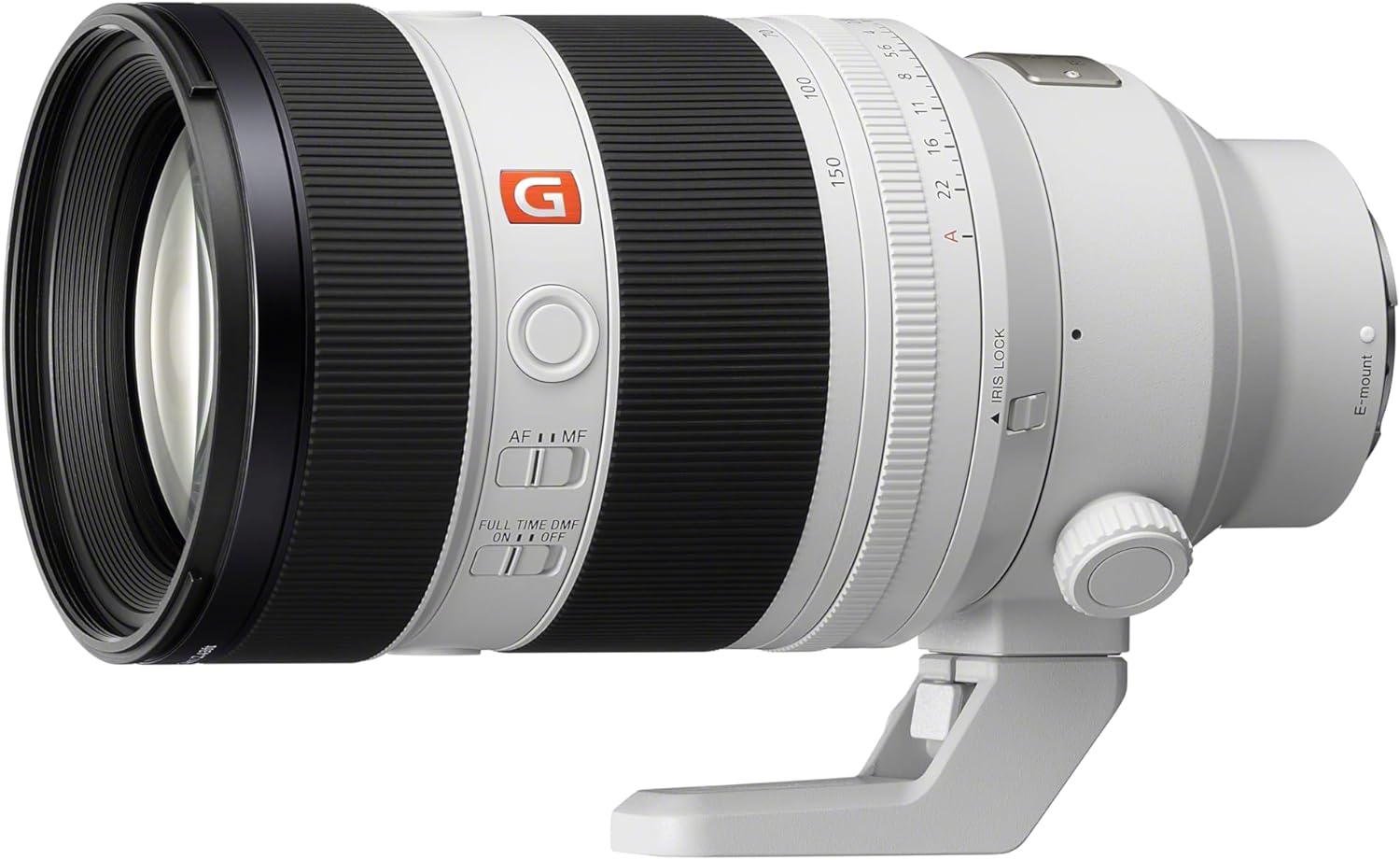
The Sony FE 50-150mm f/2 GM is a telephoto zoom lens with a constant f/2 maximum aperture throughout its range. It uses 21 elements in 15 groups, including XA, Super ED, aspherical, and ED elements, with an 11-blade circular aperture. The lens features four XD Linear Motors for autofocus, internal zoom design, and weighs 1,340g. It has an 82mm filter thread, focuses down to 0.4m with 0.28x magnification, and includes dust and moisture-resistant sealing. The lens does not have optical image stabilization.
- World’s first 150mm telephoto zoom with constant f/2 aperture provides full-stop advantage over f/2.8 competitors throughout range.
- Replaces multiple prime lenses while maintaining G Master optical quality with exceptional sharpness and smooth bokeh.
- Internal zoom design maintains consistent length and center of gravity, making it ideal for gimbal work and handheld shooting.
- Premium $3,900 price point makes it one of Sony’s most expensive lenses after super-telephoto exotics.
- Does not support teleconverters, limiting maximum reach extension options.
- At 1,340g (2.95 lbs), it’s heavier than traditional f/2.8 zooms, though lighter than carrying multiple primes.
- Focal Length: 50-150mm
- Maximum Aperture: f/2 (constant)
- Minimum Aperture: f/22
- Lens Construction: 21 elements in 15 groups (XA, Super ED, aspherical, ED elements)
- Aperture Blades: 11 (circular)
- Minimum Focus Distance: 1.3 feet (0.4m)
Sigma 300-600mm f/4 DG OS | Sports
When we tested the Sigma 300-600mm f/4 DG OS Sports for E-Mount, I said that it’s “a lens Sony should have made.” By that I mean that this lens beats out Sony’s 200-600mm lens’ variable f/5.6-6.3 by 1.5 stops at the telephoto lens. The result is a fantastic range with vastly better light gathering than Sony’s 200-600mm and a background defocus that looks much better than that on the Sony lens.
It’s also a well-designed lens that would look right at home on the sidelines of a professional sporting event. It’s large without being ungainly, and feels built like a tank thanks to the magnesium chassis. Even at nearly nine pounds, it can be handheld (until your shoulders start to hurt) because its weight is well balanced. The ARCA-SWISS tripod mount makes a great carrying handle and makes tripod mounting easy.
There’s a drop-in filter space at the camera-end of the lens, which is needed because the front lens is too massive for filters to be easy to use.
The one drawback with this lens is that the framerate is limited to 15 frames per second on the Sony platform. This is apparently a Sony-imposed limitation and doesn’t apply to the L-Mount version.
Watch Our Hands-On Review Video
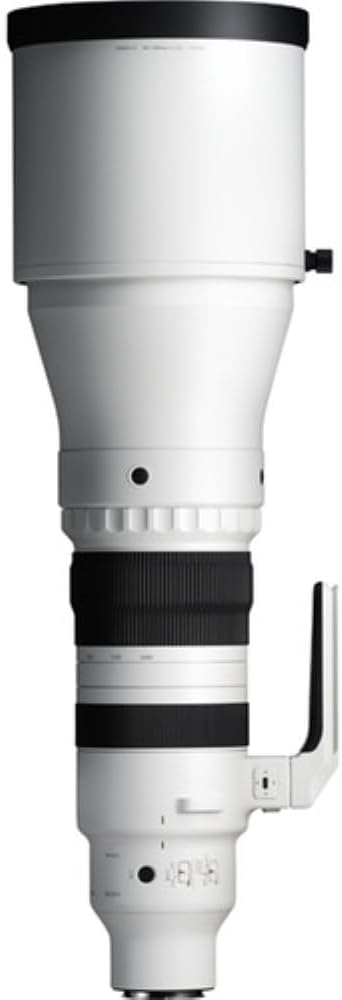
The Sigma 300-600mm f/4 DG OS Sports is an ultra-telephoto zoom with a constant f/4 aperture using 28 elements in 21 groups, including 6 FLD and 1 SLD elements. It features a High-response Linear Actuator for autofocus, OS2 stabilization rated at 5.5 stops at 600mm, and 13 rounded aperture blades. The lens has a 1.6-inch (40.5mm) rear drop-in filter holder, focuses from 9.2 feet (280cm) at the wide end to 14.8 feet (450cm) at the telephoto end, and weighs 8.8 lbs (3,985g). Construction includes magnesium alloy with thermal insulation coating and measures 6.6 inches (167mm) in diameter by 18.4 inches (467.9mm) in length.
- Delivers prime-level optical performance throughout the entire 300-600mm range at constant f/4 aperture, unprecedented for zoom lenses.
- Priced at $6,000, costs approximately half of competing 600mm f/4 prime lenses while offering zoom versatility.
- High-response Linear Actuator (HLA) provides fast, precise autofocus combined with 5.5 stops of optical stabilization.
- Substantial size at 167mm diameter and 467.9mm length requires significant carrying commitment.
- Weight of 3,985g (8.79 lbs) makes it challenging for extended handheld shooting without support.
- Not available for Canon RF mount, limiting accessibility for Canon shooters.
- Focal Length: 300-600mm
- Maximum Aperture: f/4 (constant)
- Minimum Aperture: f/22
- Lens Construction: 28 elements in 21 groups (6 FLD, 1 SLD)
- Aperture Blades: 13 (rounded)
- Minimum Focus Distance: 280cm (W) – 450cm (T)
Nikon Z 35mm f/1.2 S
In a year of great lens offerings, this was one of my favorites. The Nikon Z 35mm f/1.2 S feels like the 35mm lens Nikon has been building toward since the launch of the Z system. A 35mm lens is one of the staples, but Nikon took this classic length and found a way to make a better 35mm in a market with a lot of good options.
The f/1.2 aperture isn’t just about shooting in lower light, though this is an excellent low-light performer. The super-wide aperture creates amazing background defocus thanks to the 11-blade aperture design. It’s hard to appreciate how much difference there is between a typical f/2.8 and an f/1.2 without trying an f/1.2. And thanks to the STM motors, this lens focuses incredibly quickly.
The optical creaminess comes with a tradeoff. This is a long and heavy piece of glass. What makes this an Editor’s Choice, though, is that the performance justifies the size and the price. If you look at the $2600 price tag and think “that’s outrageous,” then you’re not incorrect. For the average shooter, this lens is overkill.
But if you’re a wedding or event photographer, a photojournalist working on editorial assignments, or a fine-art photographer, this lens is easily one of the best Nikon has ever made.
Watch Our Hands-On Review Video
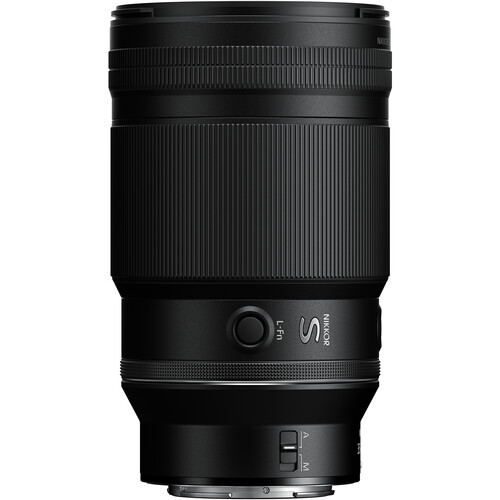
The Nikon Z 35mm f/1.2 S is a wide-angle prime lens with an f/1.2 maximum aperture using 17 elements in 15 groups, including 3 ED elements, one aspherical ED element, and three aspherical elements. It features a Multi-Focus System with two high-precision STM autofocus motors working in tandem for precise focusing, and 11 rounded aperture blades. The lens weighs 2.33 lbs (1,060g), measures 3.5 x 5.9 inches (90mm x 150mm), has an 82mm filter thread, and focuses down to 0.95 feet (0.29m) for 1:4.6 (0.2x) maximum magnification. It includes Meso Amorphous Coat, Nano Crystal Coat, and ARNEO Coat coatings with dust and drip-resistant sealing.
- Delivers exceptional sharpness even wide open at f/1.2 with excellent performance across the entire frame at all apertures.
- Beautiful rendering with soft, smooth bokeh characteristics and no onion rings or soap-bubble effects in out-of-focus areas.
- Fast, accurate autofocus with dual STM motors provides reliable tracking and precise focus even at razor-thin depth of field.
- Substantial weight at 2.33 lbs (1,060g) and 5.9-inch (150mm) length make it challenging for extended handheld shooting.
- Premium pricing at $2,800 positions it significantly above Nikon’s f/1.4 ($630) and f/1.8 ($600) alternatives.
- Autofocus speed is somewhat slower than Nikon’s f/1.8 version, requiring 0.66 seconds from infinity to minimum focus distance.
- Autofocus Motor Type: Dual STM Motors
- Image Stabilization: No
- Lens Mount Compatibility: Nikon X Z Mount
- Weather Sealing: Yes
- Lens Construction: 17 elements in 15 groups (3 ED, one aspherical ED, three aspherical)
- Aperture Blades: 11 (rounded)
Sony FE 100mm F2.8 Macro GM OSS
This is my favorite lens in this Editor’s Choice guide, but it’s not a lens everyone will love as much as I do. Macro photography is specialized, and there are dozens of mediocre macro lenses on the market. Some aren’t even macro; even though they have macro in their names, they’re just close-up lenses.
A true macro lens magnifies at least 1:1 lifesize, and this lens is 1.4x lifesize, and can be combined with Sony’s teleconverters to increase the magnification. The autofocus speed is amazing. It’s capable of tracking flying insects without any problems. It’s also a great portrait lens, although it’s not as fast as Sony’s 135mm GM. Still, it does double duty, which makes it an even better choice.
If you shoot macro, I think this is the best lens ever made.
Watch Our Hands-On Review
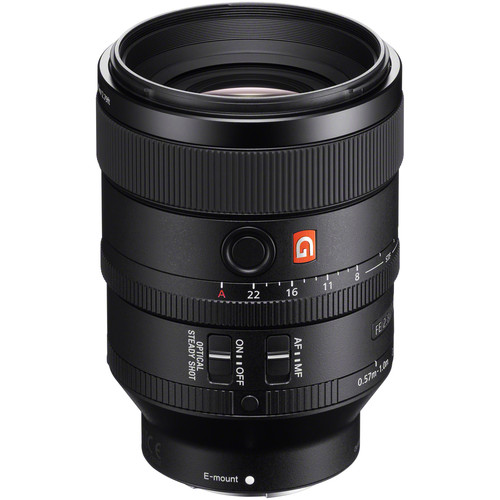
The Sony FE 100mm f/2.8 Macro GM OSS offers 1.4-times magnification for close-up subjects. Optical SteadyShot stabilization supports handheld shooting. The floating-focus system maintains detail during close-range adjustments.
- 1.4× magnification extends macro capability beyond 1×
- OSS provides useful stability in low-light or handheld macro
- Excellent frame-wide sharpness and contrast
- Smooth focus transitions for close-up video work
- On the heavier side for Sony macro options
- Focus breathing is visible at some distances
- Magnification: 1.4 times
- Minimum Focus Distance: 0.25 meters
- Stabilization: Optical SteadyShot
- Weight: 715 grams
Canon RF 85mm f/1.4 L VCM
The 85mm f/1.4 L VCM is an interesting lens in the RF lineup. 85mm is a great focal length for portraits, and Canon has an RF 85mm f/1.2, which at $3000 is on the pricy side for many Canon shooters. This 85mm f/1.4 is around half the price, and the image quality is excellent. We found it hard to find anything wrong with the image quality compared to the f/1.2. The f/1.4 aperture is just a half stop narrower than f/1.2, so there’s very little light gathering loss, and while the background on the more expensive 85mm is softer, I don’t see enough difference for the average Canon shooter. Not only is it less expensive, but it’s also lighter and smaller.
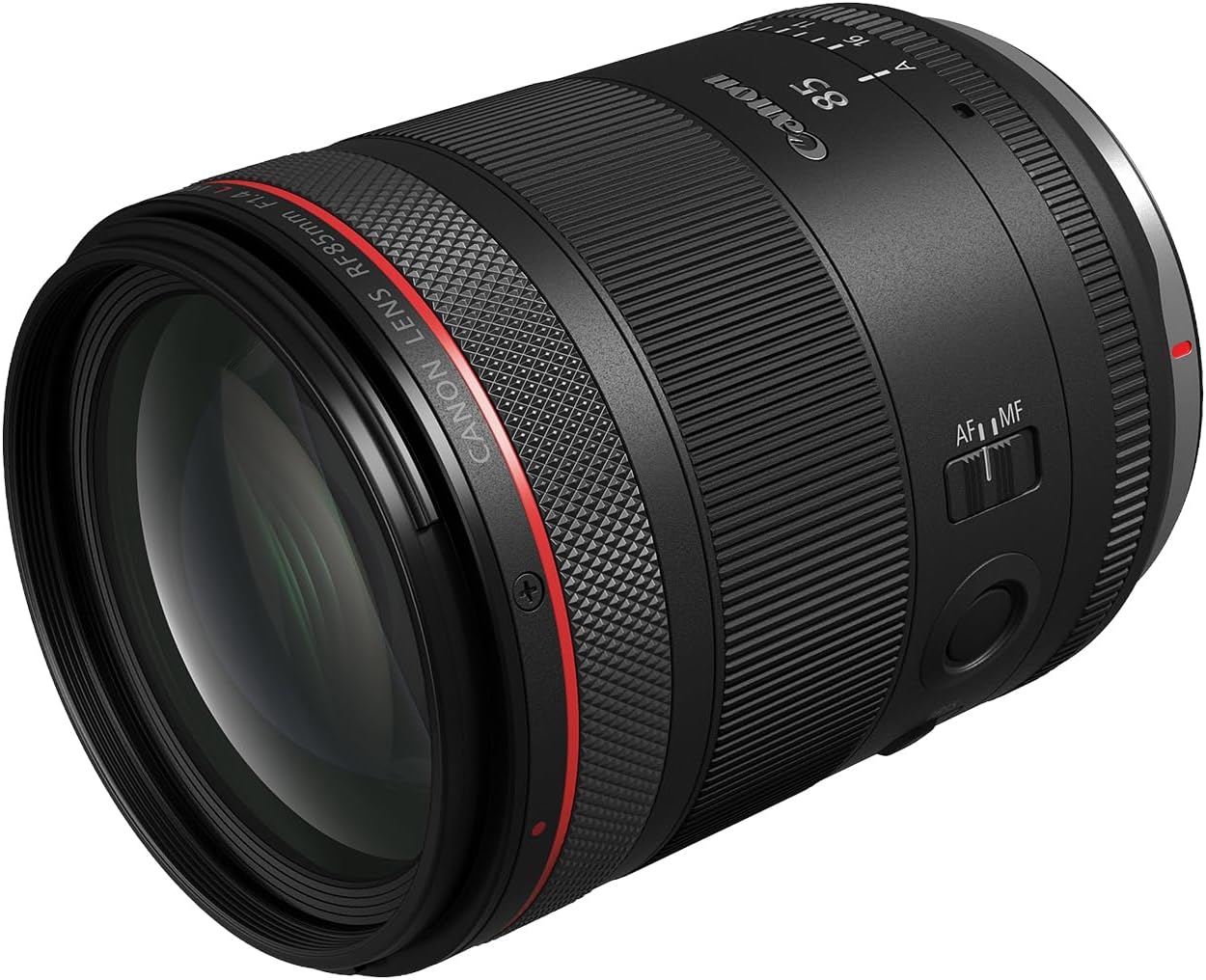
The Canon RF 85mm f/1.4 L VCM is a portrait prime with an f/1.4 maximum aperture using 14 elements in 10 groups, including 1 UD and 1 GMo aspherical element. It features Voice Coil Motor autofocus, 11 circular aperture blades, and weighs 636g. The lens measures 76.5mm x 99.3mm, has a 67mm filter thread, focuses down to 0.74m for 0.12x magnification, and includes Air Sphere ASC coating with fluorine front coating. It has dust and splash-resistant L-series sealing and does not include optical image stabilization.
- Extremely sharp throughout the entire frame, even wide open at f/1.4, with faster autofocus than the heavier f/1.2 version.
- Much more portable at 636g versus 1,195g for f/1.2 makes it practical for all-day shooting and travel.
- Perfect size and weight balance for hybrid shooters, matching other VCM primes with a 67mm filter thread for quick swaps.
- No image stabilization, unlike the RF 85mm f/2 Macro, which requires body IBIS or higher shutter speeds.
- The aperture ring is only fully functional in photo mode on the newest bodies (R1, R5 Mark II).
- RF 135mm f/1.8 L remains sharper at close distances for pixel-peepers, and f/1.2 still produces creamier bokeh.
- Focal Length: 85mm
- Maximum Aperture: f/1.4
- Minimum Aperture: f/16
- Lens Construction: 14 elements in 10 groups (1 UD, 1 GMo aspherical)
- Aperture Blades: 11 (circular)
- Minimum Focus Distance: 29 inches (0.74m)
Tamron 16-30mm f/2.8 Di III VXD G2
I spent two weeks testing this lens in Australia, and it barely left my camera. The only time I swapped it out was to shoot wildlife. The closest competitor to the 16-30mm f/2.8 Di III VXD G2 is Sony’s 16-36mm f/2.8 GM II, which is more than twice the price of the Tamron. Optically, the Sony GM lens is superior, but not in significant ways for most photographers. The Tamron lens is sharp, the color rendition is excellent, and the body is durable but very small and light.
I’ve recommended this lens, combined with the Sony a7 IV (before the a7 V was released), as a great wide-angle to keep gear costs down. It’s even affordable enough that for the same price as the a7 IV and the Sony 16-35mm, a photographer could get this lens and the a7R V.
Watch Our Hands-On Review Video
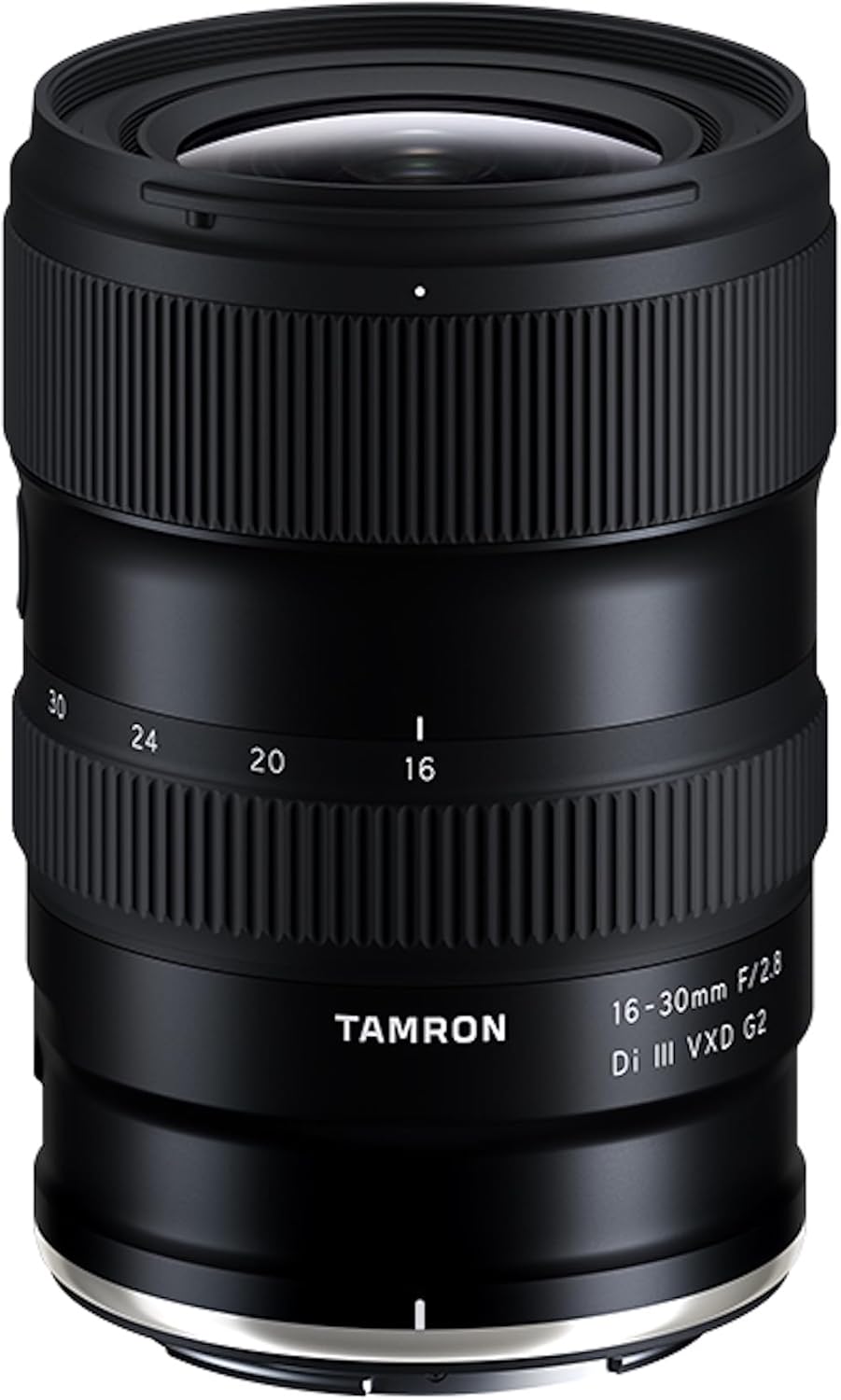
The Tamron 16-30mm F2.8 Di III VXD G2 is a compact wide-angle zoom lens designed specifically for Sony E-mount mirrorless cameras. This second-generation lens features improved optics, faster autofocus, and weather sealing, making it an excellent choice for landscape, architecture, travel, and street photography. The 16-30mm focal range covers ultra-wide to natural wide-angle perspectives with a constant f/2.8 aperture throughout.
- Excellent sharpness across the focal range
- Fast and silent VXD autofocus motor
- Weather-sealed build with USB-C port for firmware updates –
- Minimal distortion at 30mm
- Outstanding value at $929 vs. $2,498 for Sony 16-35mm GM2 – Compact and lightweight for travel – Constant f/2.8 aperture
- No aperture ring on the lens barrel
- Some lens flare when shooting directly into the sun
- More flare than the Sony 16-35mm GM2 in backlit situations
- Focal Length: : 16-30mm
- Maximum Aperture: /2.8 (constant throughout zoom range)
- Minimum Aperture: f/16
- Lens Construction: 16 elements in 12 groups
- Aperture Blades: 9 (circular diaphragm stays nearly circular up to two stops down)
- Minimum Focus Distance: 0.19m (7.5 inches) at 16mm, 0.3m (11.8 inches) at 30mm
- Autofocus Motor: VXD (Voice-coil eXtreme-torque Drive) linear motor
- Weather Sealing: : Yes, with moisture-resistant construction
- Lens Mount: Sony E-mount and Nikon Z-mount
- Weight: 440g (15.5 ounces)
- Length: 101.8mm (4 inches)
- Diameter: 74.8mm